


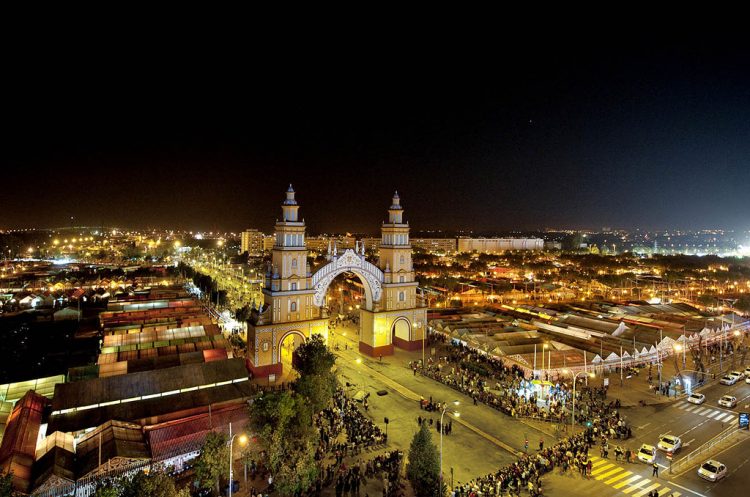
Guide to enjoy the April fair in Seville in 2020
Without a doubt, the Seville April Fair is known within and outside our borders. This year 2020, from April 26 until May 2, you will have an appointment with this festival declared International Tourist Interest. So if you have to mark a date on your calendar to visit Seville, that is the April Fair.
The night of the pescaíto, the alumbrao, the sevillanas, the rebujito ... All these are the signs of identity of this historic event that has been held every year in Seville for centuries. Like the Holy Week, the other Sevillian spring date par excellence, the Feria de Abril retains its essence and tradition.
From Eva Recommends we want you to not miss any of the April Fair of Seville 2019, so here we leave you our guide with everything you need to know to enjoy it from start to finish.
Origins of the Seville Fair of April
To understand the essence of the Seville Fair of April, it is necessary that we go back to its origins. It was in the mid-nineteenth century when two entrepreneurs from the north of the country and settled in Seville came up with the idea of holding an annual fair for the purchase and sale of livestock. These two councilors, named José María Ybarra and Narciso Bonaplata, presented the proposal to Queen Isabel II in 1846. After the approval of his majesty, on April 18, 1847, the first fair was held at the Prado de San Sebastián, a which was attended by about 25,000 people.
Over the years, the fair has become one of the most important festivities in the city, changing its mercantile character to that of social celebration. Due to its high number of visitors, in 1973, after having been interrupted two years by the Civil War, it was moved to its current location.
La Portada, the iconic element of the April Fair
If something characterizes the April fair, that is its cover. Each year it is renewed, making reference to an icon different from the capital of Seville. This ephemeral construction is the gateway to the Real and the meeting point, and disagreement, in the fairgrounds. This year the winning proposal has been the work of Ángelo González Carvalho, through which he pays tribute to the building of the Casino of the Seville Exhibition.
At 12 o'clock on the night of May 4, with the lighting of the cover, the Fair officially begins. The person in charge of lighting it will be a citizen of Seville chosen by lot among all the registered ones.
The little fish
The pescaito is the previous dinner between friends and relatives who meet in the different private booths of the fair before the light. The menu is thematic and immovable.
Although in its origins the tradition established this day on Monday, today is celebrated on the previous Saturday. Without a doubt, it is a ritual for both the fairboarders and partners of booths and for those who can not get close to Los Remedios on their first day and choose to "eat fried fish" in their homes and then go to Real.
The booths
Real, that is the name given to the fairgrounds. It is located in the neighborhood of Los Remedios and currently occupies a total of 1,200,000 square meters divided into three different areas: the Calle del Infierno, El Real de la Feria and the car parks.
The Real de la Feria is divided into 15 streets, whose names correspond to an important bullfighting figure. This is where the booths are located, the home of the Sevillians during this week of singing, dancing and joy. There are a total of 1,052 booths distributed as follows: 513 families, 519 entities, 3 municipalities, 6 districts and 11 services.
Therefore, if you want to enjoy an authentic fair day, you can either go to one of the private booths as long as you have received the corresponding invitation to enter them, or go to one of the free entry booths.
Wherever you enjoy this particular Sevillian party, do not forget to order a rebujito, the official drink of the April Fair in Seville made from chamomile and mixed with a carbonated drink with lime and lemon flavor.
Sevillanas and dance!
As pointed out in his writings by the poet and folklorist Francisco Rodríguez, one has to go back to the 17th century to find the origins of the sevillanas.
The sevillanas of four in four, did not arrive until the decade of the sixties with the brothers Reyes and the Toronjo brothers, who "codify the modern Seville, sung with groups of four, with thematic unit and with musical unity, since before the sevillanas were they sang singles, and from that codification of the sixties a gradual development with new popular groups began and also the sevillanas biblical ", explains the Professor of Social Anthropology of the Hispalense.
We hope that this guide has helped you and that you enjoy to the fullest of another of the Great Weeks of Seville